Mosque fit out in Dubai: scope, approvals and cost (2026)
A mosque fit out in Dubai is a specialist interior contract covering the prayer hall, qibla wall and mihrab, minbar, floors, ablution areas and acoustics, and it cannot start without IACAD, Dubai Municipality and Dubai Civil Defence sign-off. On a 300 sqm prayer hall, budget AED 320,000 to 650,000 for the joinery package and allow 8 to 14 weeks from permit to handover.
Why work with Malak Afzal
- Interior fit-out and bespoke joinery contractor for mosques, retail, hospitality and residential fit-out
- Mosque, musalla, retail and hospitality projects delivered under one contract
- In-house joinery workshop controlling the joinery and civil interface
- Itemised fixed-price quotes with joinery rates given per linear metre
- Documented support for IACAD, Dubai Municipality and Dubai Civil Defence submissions
- Direct line to the project team on WhatsApp and phone at +971 55 131 7286
Malak Afzal delivers mosque fit-out under the same interior fit-out and joinery services scope as its retail, hospitality and residential work, so the workshop that carves a minbar also sets the ceiling grid it sits under.
What a mosque fit-out package actually covers
A mosque fit-out package covers every finished surface and fitted element inside the prayer space, plus the ablution block and the support rooms around it. Joinery sits at the centre of that scope, but it only works when civil, MEP, stone and acoustics are coordinated on one drawing set.
- Prayer hall: floor finishes, wall linings, ceiling, lighting coves and ventilation grilles set flush with the ceiling plane.
- Qibla wall and mihrab: the focal wall, the mihrab niche, carved or CNC profile work, calligraphy panels and the lighting that washes them.
- Minbar: fixed or movable, with steps, handrail, storage under the platform and a finish matched to the mihrab.
- Decorative ceiling: coffers, domes, stretched fabric, gypsum features and concealed lighting.
- Carpet and stone floors: carpet tiles or broadloom in the sajdah rows, stone or porcelain in circulation and entry.
- Ablution and wudu areas: moisture-rated joinery, bench seating, tap and mixer positions, and drainage falls set by the MEP contractor.
- Shoe storage: open or closed units at entry points, sized for peak Friday attendance rather than the daily average.
- Imam's room and madrasa or majlis seating: fixed benches, storage, teacher's desk and AV points.
- Acoustic panels: positioned to control reverberation so the khutbah stays intelligible at the back of the hall.
Approvals before you cut a single panel
You need IACAD approval of the layout and qibla line, a Dubai Municipality or DDA permit for the internal works, and a Dubai Civil Defence submission for assembly occupancy, all before fabrication starts. A fully coordinated design can still sit in a drawer for six weeks if the submission set is incomplete.
IACAD (Islamic Affairs) reviews the prayer layout, qibla direction, mihrab position, women's prayer area, entry separation and, where relevant, the minbar and its placement. Dubai Municipality or DDA issues the building permit for internal works, which is why consultant-stamped drawings matter. Dubai Civil Defence treats the room as an assembly space and looks at occupant load, exit widths, travel distance, emergency lighting, and the fire performance of ceiling and wall linings.
Fit-out of an existing shell is far faster than new build. There is no structure, no envelope and no external approval chain, so the process narrows to internal works approvals and a final occupancy inspection.
The document set usually requested:
- Trade licence, plus the IACAD registration for the mosque or prayer space.
- Layout drawings showing the qibla line, mihrab, minbar, prayer rows, women's area and the shoes-off threshold.
- Dubai Municipality or DDA permit application with consultant-stamped architectural, structural and MEP drawings.
- Civil Defence submission with occupant load calculation, exit widths, travel distances, emergency lighting layout and material fire certificates.
- Building owner or master developer NOC if the musalla sits inside a mall, office tower or mixed-use building.
- Material submittals, finish schedule and a physical sample board signed off before bulk joinery production.
Materials that survive a Dubai prayer hall
Specify solid wood for the minbar and mihrab, WBP plywood with waterproof adhesive in wudu areas, and stone or porcelain at entry and circulation, because the finishes that fail here are the ones meeting water, heat and heavy foot traffic at the same time.
| Element | Specification to write into the BOQ | Why it matters here |
|---|---|---|
| Minbar | Solid kiln-dried teak or ash with stainless fixings | Holds shape through the summer humidity swings that move cheaper timbers |
| Mihrab and qibla wall | Solid hardwood profile over a moisture-resistant substrate, not MDF | MDF swells and loses its carved edge in air-conditioned halls with heavy use |
| Wudu cabinetry | WBP exterior-grade plywood, waterproof adhesive, sealed edges, marine-grade hardware | Standing water and daily wash-down destroy standard particleboard within a season |
| Sajdah row | Carpet tiles or broadloom with dense pile over a rubber underlay | Softer underfoot and easier to rotate when one row wears ahead of the rest |
| Circulation and entry | Matt or honed porcelain and natural stone | Handles shoes, sand and wet feet better than a polished surface |
| Ceiling and rear wall | Perforated acoustic panels with mineral or felt backing | Controls reverberation so the khutbah reads clearly at the back of the hall |
Solid wood, veneer on a stable substrate and MDF are not interchangeable. Use solid wood where hands touch and where carving must hold an edge, veneer only on flat decorative panels that never see moisture, and leave MDF out of wudu areas and minbar construction altogether. Sound-absorbing perforated panels behind the mihrab and along the rear wall cut the flutter echo that makes a khutbah sound muddy in a hall finished in stone, gypsum and glass.
In-house joinery vs subcontracted joinery
One workshop controlling the joinery removes the joinery and civil interface that delays most mosque fit-outs. When joinery is subcontracted, a late minbar becomes the fit-out contractor's problem and a ceiling height that moved becomes the joiner's problem, and both conversations land on your programme.
- Carved profiles and calligraphy matched across the minbar, mihrab and qibla wall from one set of shop drawings.
- Sample or prototype sign-off before bulk production, so the committee approves grain, sheen and colour in daylight rather than in a catalogue.
- Delivery in installation sequence: ceiling grid first, then qibla wall, then minbar, then wudu cabinetry.
- One party accountable for the joinery, MEP and stone interfaces, which is where most snag lists grow.
See the completed mosque and retail joinery projects for how that sequencing runs on a live site.
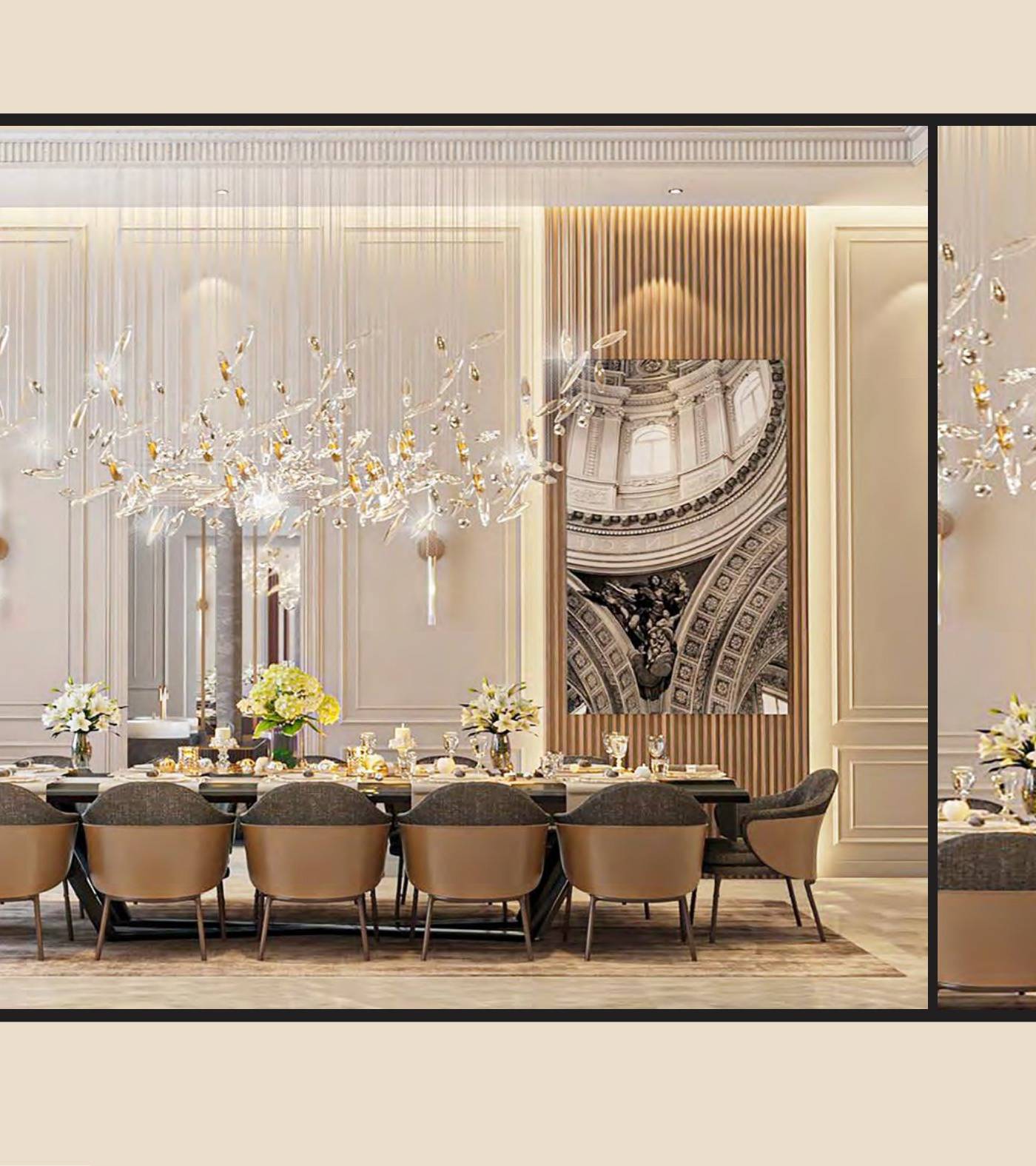
A 3D render from the design stage, showing the paneling, table and lighting treatment agreed before joinery production begins.
Indicative 2026 AED pricing for a mosque fit out in Dubai
For a 300 sqm prayer hall, the joinery package typically lands between AED 320,000 and 650,000 lump sum, driven by how much carving is specified, the wood species chosen and the ceiling design.
| Item | Basis | Indicative 2026 range |
|---|---|---|
| Qibla wall and mihrab joinery | Lump sum | AED 45,000-95,000 |
| Solid-wood minbar | Lump sum | AED 30,000-75,000 |
| Decorative ceiling | Per sqm | AED 150-350 |
| Wudu area cabinetry | Lump sum | AED 25,000-60,000 |
| Acoustic paneling | Per sqm | AED 180-320 |
Worked example on 300 sqm: qibla wall and mihrab at AED 60,000, minbar at AED 45,000, 300 sqm of decorative ceiling at AED 200 per sqm (AED 60,000), 120 sqm of acoustic paneling at AED 250 per sqm (AED 30,000) and wudu cabinetry at AED 38,000. That totals AED 233,000 before carpet, shoe storage, imam's room joinery and madrasa seating, which is why realistic joinery packages on this size of hall settle around AED 400,000 and above. Add MEP, lighting, stone and civil works, and the full fit-out on 300 sqm generally sits between AED 1.1m and 1.9m.
To price your own hall, request a mosque fit-out site visit and fixed price with a measured survey, a qibla line check and an itemised joinery schedule.
Programme, quote comparison and Ramadan planning
Eight to 14 weeks from permit to handover is normal for a 300 sqm prayer hall, and the schedule is dominated by joinery production and inspection slots rather than site labour.
Typical programme
- Weeks 0-1: site survey, laser measure, qibla line check, and a survey of existing MEP and ceiling void.
- Weeks 1-3: shop drawings, sample board sign-off and material orders placed.
- Weeks 3-8: joinery production in the workshop while site enabling works run in parallel.
- Weeks 6-11: ceiling and acoustic installation, wall linings, and first fix behind joinery.
- Weeks 9-13: qibla wall, mihrab, minbar, wudu cabinetry and shoe storage installed.
- Weeks 12-14: stone or carpet, snagging, Civil Defence and IACAD final walkthrough, handover.
Three decisions that add weeks
- An IACAD layout change after shop drawings are issued, which forces a fresh submittal and stops fabrication.
- Switching wood species or ceiling design after sample sign-off, which restarts procurement and lead times.
- Deciding the minbar must be fixed rather than movable once the floor and understructure are already in.
How to compare mosque fit-out quotes
Insist on itemised joinery rates per linear metre for the minbar, mihrab and cabinetry, because a lump sum tells you nothing about where the money sits.
- Material specs naming species, panel thickness, plywood grade, adhesive type and hardware brand.
- Who carries the IACAD and Civil Defence resubmission risk if the layout changes mid-project.
- Whether joinery is produced in-house or subcontracted, and who owns that programme risk.
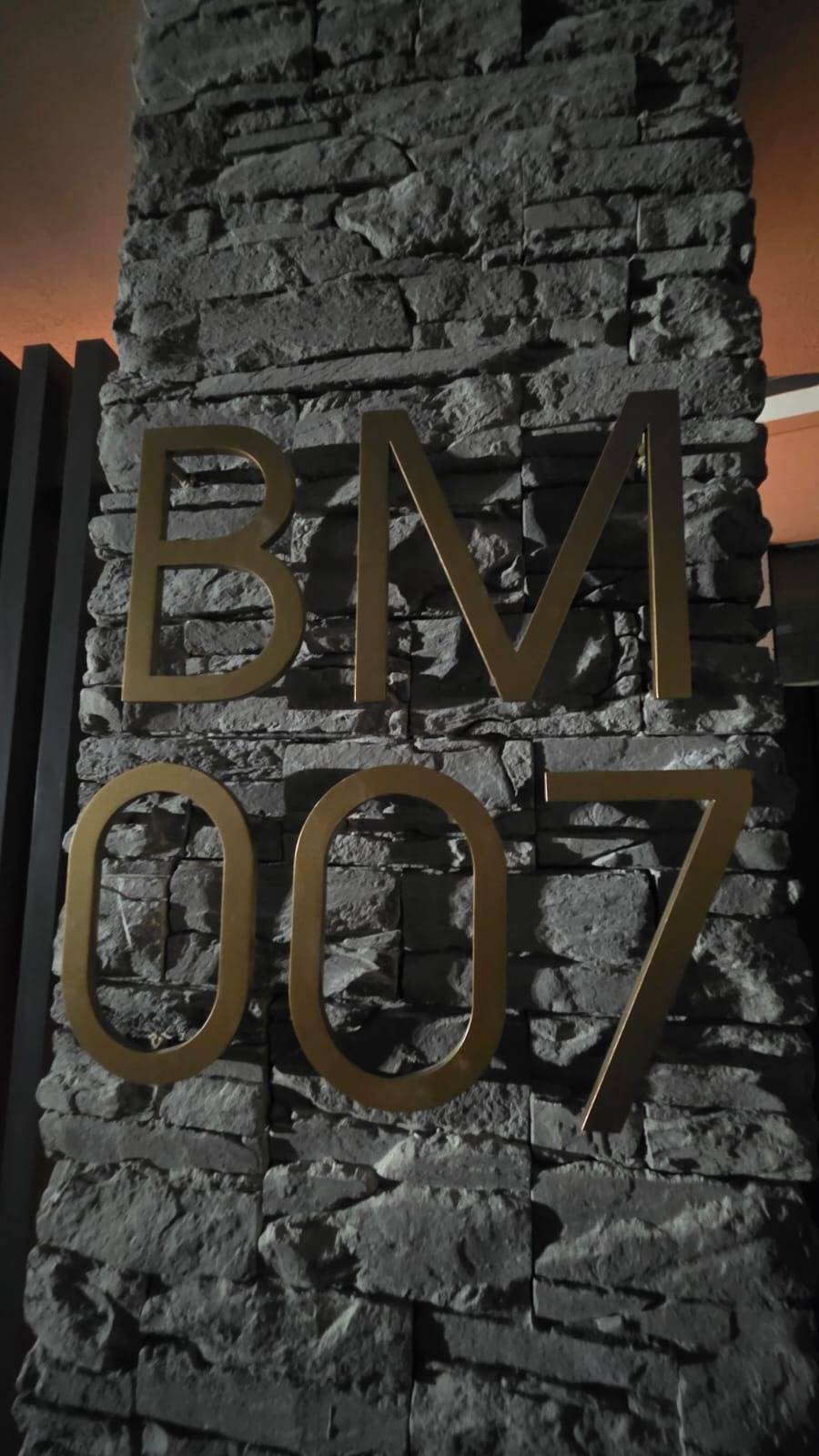
Feature wall and metal lettering detail photographed on a completed commercial project.
Planning around Ramadan and khutbah dates
Set the handover date first and work backwards from it. Aim to finish 4 to 6 weeks before Ramadan so snagging, deep cleaning and acoustic tuning happen while the hall is empty, and so a delayed Civil Defence inspection slot does not push the first tarawih prayer. For more on sequencing joinery packages, the fit-out and joinery guides cover material and programme decisions in more detail.
Frequently asked questions
How much does a mosque fit out cost in Dubai?
For a 300 sqm prayer hall the joinery package runs from AED 320,000 to 650,000 lump sum. Decorative ceilings sit at AED 150 to 350 per sqm and acoustic paneling at AED 180 to 320 per sqm. Add MEP, lighting, stone and civil works and the full interior fit-out usually lands between AED 1.1m and 1.9m.
Do I need IACAD approval for a musalla fit out in Dubai?
Yes. IACAD reviews the prayer layout, qibla direction, mihrab position and women's prayer area before internal works proceed. You also need a Dubai Municipality or DDA permit for the fit-out itself and a Dubai Civil Defence submission covering assembly occupancy, exit widths and fire-rated linings.
How long does a mosque fit out take in Dubai?
Expect 8 to 14 weeks from permit to handover on an existing shell. Add 3 to 6 weeks for approvals if the drawings are not submission-ready. Changes to the layout or the wood species after sample sign-off are the most common cause of slippage.
What is the best wood for a minbar and mihrab in Dubai?
Solid kiln-dried teak or ash performs best because it holds a carved edge and resists the humidity swings of an air-conditioned hall. Veneer is acceptable on flat decorative panels over a stable substrate but not in wudu areas. MDF should stay out of both the minbar and the ablution joinery.
Can a musalla be fitted out inside an existing office building or mall?
Yes, and it is usually faster than a standalone build because the structure and envelope already exist. You still need the building owner's NOC, a Civil Defence review of occupant load and exit widths, and IACAD sign-off on the layout. Separate entries, shoe storage and wudu drainage are the details that decide whether the space works.
How do I compare mosque fit out quotes in Dubai?
Ask for itemised joinery rates per linear metre rather than one lump sum, plus material specifications naming species, plywood grade and hardware. Confirm who carries the IACAD and Civil Defence resubmission risk if the layout changes. Finally, check whether the joinery is produced in-house, because a subcontracted shop is the most common source of programme slippage.