Mosque joinery cost Dubai: prayer hall fit-out prices
Mosque joinery in Dubai usually lands between AED 250,000 and 400,000 for a 300 m2 prayer hall when the mihrab, minbar, qibla wall cladding, screens, ceiling joinery and doors are delivered as one package. Element pricing is tighter: a wudu area locker runs AED 1,800 to 3,500, a carved hardwood minbar reaches AED 120,000. The gap between a low quote and a high one is rarely the labour rate. It is the timber, the fire rated finish system, the size of the hall and the approval pathway.
Why work with Malak Afzal
- Dubai-based interior fit-out and bespoke joinery contractor
- Google rating 4.8 from 27 reviews
- In-house team from concept and design through to execution and finishing
- Mosque, retail, hospitality and residential fit-out under one contract
- Fixed-price, itemised mosque joinery quotations
What counts as mosque joinery in a prayer hall
Mosque joinery is every fixed timber element inside the prayer hall and its support areas, from the mihrab and minbar to the doors and screens that organise movement through the building. It is a specialist package with its own drawings, fire documentation and finish testing, not general carpentry.
The items normally priced in a Dubai mosque fit out:
- Mihrab: the qibla niche, built as a framed timber or stone-faced panel, often with a carved calligraphy band.
- Minbar: the stepped pulpit, usually the most complex and most expensive single item in the room.
- Qibla wall cladding: slatted or veneered timber, CNC screens, sometimes with acoustic backing.
- Maqsura screens: fixed or sliding dividers between worshippers and around the imam area.
- Prayer hall ceiling joinery: coffers, timber battens and perimeter bulkheads that conceal services.
- Entrance doors: main double doors, side exits and internal door sets.
- Wudu area joinery: shoe and abaya lockers, benches, vanity carcasses and partitions.
All of it has to be drawn, approved, fabricated to a moisture-tested finish and installed without disrupting daily prayers. That last constraint shapes more of the cost than most committees expect, and it is why a contractor with bespoke joinery and interior fit-out services on both the commercial and religious side tends to price more accurately.
Mosque joinery cost in Dubai: real AED price bands
Most Dubai mosque joinery is priced element by element rather than as one lump sum, because mihrab, minbar and ceiling work are rarely won at a single supplier. Typical bands:
| Element | Typical Dubai range |
|---|---|
| Carved hardwood minbar, 3 to 5 steps | AED 45,000 to 120,000 |
| Mihrab feature wall with calligraphy banding | AED 25,000 to 80,000 |
| Qibla wall timber cladding | AED 350 to 650 per m2 |
| Maqsura and imam area screens | AED 1,200 to 2,600 per linear metre |
| Prayer hall ceiling joinery | AED 280 to 520 per m2 |
| Wudu area lockers | AED 1,800 to 3,500 per unit |
| Main entrance doors in solid hardwood | AED 12,000 to 30,000 per set |
A worked example for a 300 m2 prayer hall with a 5.5 m ceiling:
- Qibla wall cladding, 60 m2 at AED 500 per m2: AED 30,000
- Carved minbar: AED 65,000
- Mihrab feature wall: AED 40,000
- Maqsura screens, 24 linear metres at AED 1,800: AED 43,000
- Ceiling battens and coffers, 300 m2 at AED 300 per m2: AED 90,000
- Wudu lockers and benches, 24 units at AED 2,200: AED 52,800
- Entrance door sets: AED 22,000
- Installation, finishing and approval coordination: AED 30,000
That package lands between AED 340,000 and 375,000 depending on the timber grade and how much carving is hand finished. A quote of AED 200,000 for the same scope usually means veneered MDF where solid hardwood was specified, or the ceiling package quietly excluded. Freight and labour rates shift between emirates, but testing and approval costs stay broadly the same wherever the hall is built.
Top interior designing company. Best in town. Very professional and knowledgable team. Quality work. Naveed Asghar, 5 out of 5
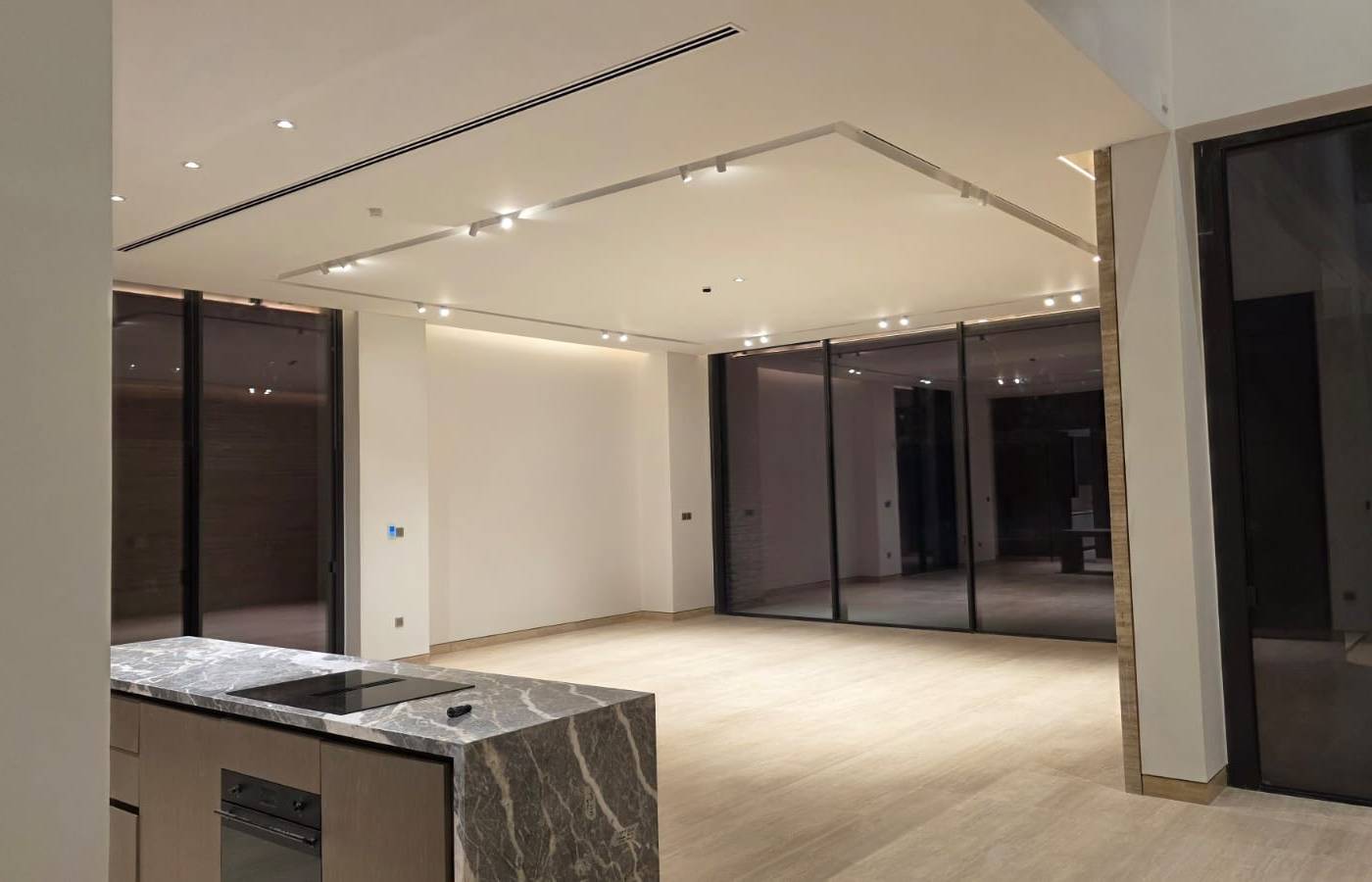 Finish quality on a completed fit-out: marble island, integrated joinery and layered lighting, the same standard mosque interior joinery in Dubai is held to.
The five cost drivers behind a mosque joinery quote
Five variables explain almost all of the spread between quotes for prayer hall joinery in Dubai. Read them in order, because the first two usually account for the biggest differences.
1. Solid hardwood versus veneer and imported timber
Solid oak, teak or ash costs three to five times more than a veneered board core, and imported hardwood adds 4 to 8 weeks of lead time to the programme. Veneer is entirely acceptable for cladding and ceilings. Solid timber earns its cost at the minbar steps, handrails and door stiles, the surfaces worshippers touch every day.
2. Fire rated and moisture tested finishes
UAE mosques need Class B or better reaction to fire on wall and ceiling timber, and finishes must survive 40 to 45 C with continuous air conditioning. A tested intumescent or fire retardant system adds roughly 15 to 25 percent to finish cost against a standard lacquer. Skipping it costs more later at snagging or Dubai Civil Defence inspection.
3. Prayer hall size and ceiling height
Cost does not scale in a straight line. A 300 m2 hall with a 5.5 m ceiling needs scaffolding, lifting and more labour per square metre than a 150 m2 hall at 3.5 m. Above 6 m, budget another 10 to 20 percent for access and safety measures.
4. Approval and permit pathway
Submissions run through the building's General Services Department, Dubai Municipality, DET and the mosque authority. Shop drawings, fire test certificates and finish specifications all form part of the pack, and one comment round can push the programme back 2 to 3 weeks.
5. Off-site workshop fabrication versus on-site work
Most mosque joinery in the UAE is fabricated off-site in workshop units around industrial districts, then delivered and fitted in phases. Workshop fabrication is faster, cleaner and cheaper per unit, and it keeps cutting and sanding out of a live prayer hall.
How long mosque joinery takes in Dubai
A full prayer hall package runs 10 to 16 weeks from scope freeze to handover, with approvals sitting in parallel rather than at the front. The stages:
- Site survey, measured drawings and scope freeze. 1 to 2 weeks.
- Design intent, shop drawings and finish samples. 2 to 3 weeks.
- Approval submission, comments and resubmission. 3 to 6 weeks, run in parallel.
- Workshop fabrication, trial assembly and quality check. 6 to 10 weeks.
- Delivery and installation. 2 to 4 weeks.
- Snagging, final finishing and handover. 1 to 2 weeks.
Installation phasing is where experience shows most. Work is scheduled between Fajr and Dhuhr and again after Isha, and never during Friday prayers. For a Ramadan overlap, plan for shorter daytime shifts, night work permissions and 1 to 2 extra weeks in the programme. It is worth booking early to arrange a prayer hall site survey before drawings are frozen.
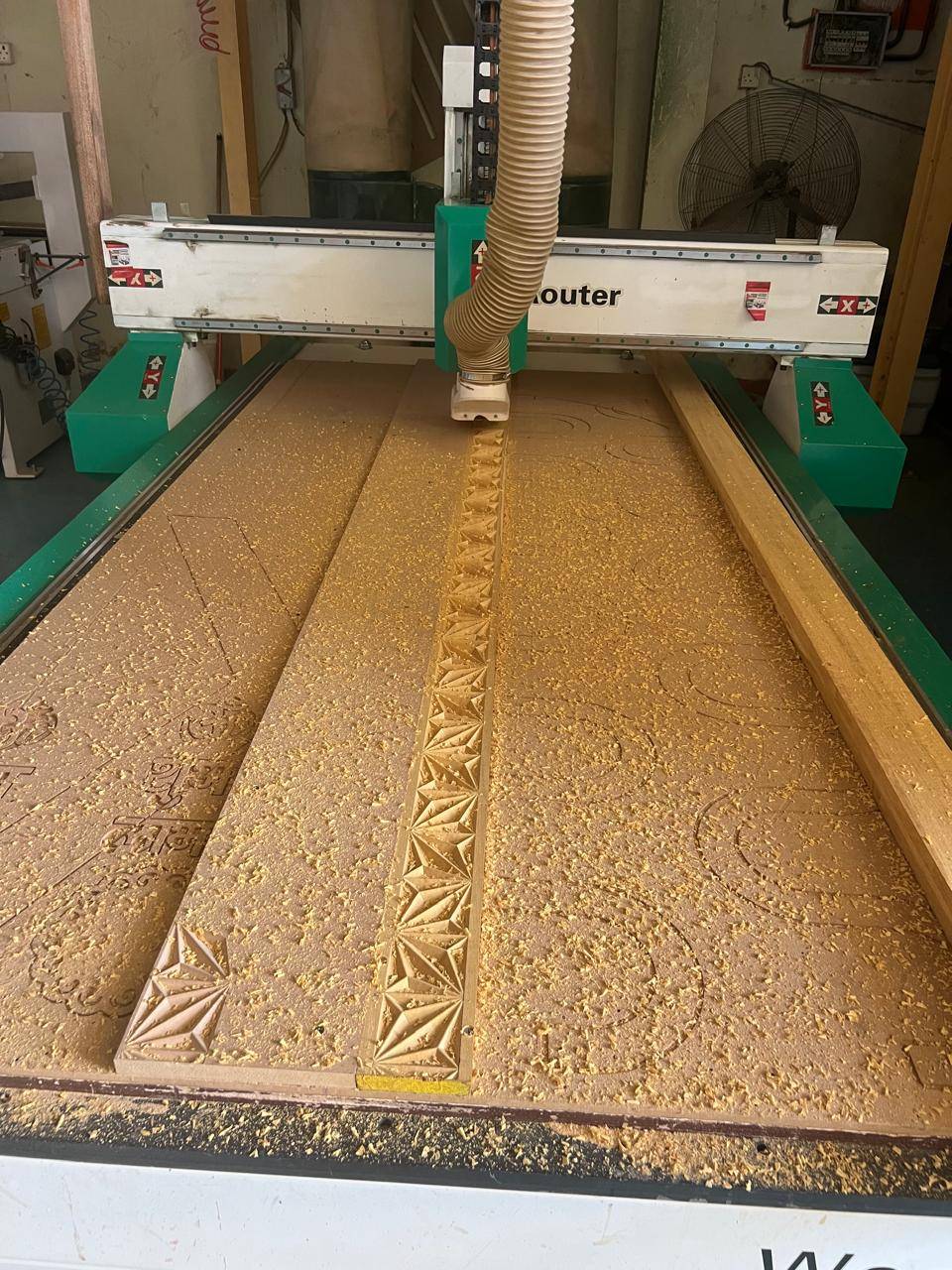 CNC cutting of geometric screen panels in the workshop, where qibla wall and maqsura detail is set before delivery.
How to compare mosque joinery quotes
Compare quotes on scope, timber specification and finish warranty, never on the headline number. Three like-for-like quotes for the same 300 m2 hall commonly spread by 30 to 40 percent, and most of that spread sits in what each one leaves out.
- Same scope: ask every contractor to price the same element list, including strip-out, making good and temporary protection.
- Same timber spec: state species, core board and veneer thickness, and refuse substitutions without a written variation.
- Same finish warranty: 3 to 5 years on workmanship and the finish system is a fair UAE baseline.
- Workshop evidence: visit the workshop or ask for dated photographs of current mosque and commercial joinery in production.
- Previous mosque references: two or three comparable halls, with the approving authority named.
Ask to see mosque and prayer hall joinery projects in Dubai as reference, then walk the site if you can.
Shukran Group of Companies is one of the best interior design companies in the UAE. Their team is professional, creative, and highly committed to delivering quality work. Haidar Ali Khan, 5 out of 5
To compare a fixed price against your current quote, send the drawings and element list through request a fixed-price mosque joinery quote or message the team on +971551317286.
Frequently asked questions
How much does mosque joinery cost per square metre in Dubai?
Most mosque joinery packages price out between AED 800 and 1,300 per m2 of prayer hall floor area once mihrab, minbar, qibla cladding, ceiling joinery and doors are combined. For a 300 m2 hall that is roughly AED 250,000 to 400,000. Element pricing is more accurate for phased work, with qibla wall cladding at AED 350 to 650 per m2 and wudu lockers at AED 1,800 to 3,500 per unit.
Is a minbar more expensive than a mihrab?
Usually yes. A carved hardwood minbar with 3 to 5 steps typically costs AED 45,000 to 120,000, while a mihrab feature wall lands between AED 25,000 and 80,000. The minbar involves more joinery, more hand carving and tighter geometry, so it is the single most expensive item in most prayer halls.
Do I need permits for mosque joinery in Dubai?
Yes. Any fixed joinery touching the structure, ceiling, electrical services or exit routes needs approval, and mosque work also runs past the Islamic Affairs and Charitable Activities Department alongside Dubai Municipality and DET. Allow 3 to 6 weeks for the pathway. Your contractor should prepare shop drawings, fire certificates and finish specs for submission, not leave that to you.
Can installation continue during Ramadan and on Fridays?
It can, with planning. Most sites stop installation work on Fridays and shorten daytime shifts during Ramadan, so the practical answer is early morning slots between Fajr and Dhuhr plus night work where permitted. Build 1 to 2 extra weeks into the programme for a Ramadan overlap and agree the prayer timetable with mosque management before mobilising.
How long is the warranty on mosque joinery?
A reasonable UAE warranty is 3 to 5 years on workmanship and the finish system, with manufacturer warranties on hardware, laminates and veneers passed through to the client. Insist that it is written into the quote and covers delamination, warping and finish failure in air-conditioned humidity. Anything under 12 months on joinery in UAE conditions is a warning sign.
Is refurbishing an existing prayer hall cheaper than a new build?
Usually 30 to 50 percent cheaper. Refurbishment can keep the structure, ceiling grid and services and replace only the joinery package, so a hall that would cost AED 350,000 new might come in at AED 180,000 to 250,000. The saving depends on how much existing timber can be stripped, re-veneered or reused, which the site survey confirms.