Mosque joinery cost Dubai: prices per element
Mosque joinery cost in Dubai typically runs from AED 95,000 to AED 150,000 for a complete 120 m² musalla package, and the minbar, mihrab and Qibla wall cladding carry most of that figure. Here is what each element costs, what pushes the number up, and how to compare quotes without guessing.
Why work with Malak Afzal
- Dubai interior fit-out and bespoke joinery contractor covering mosques, retail, hospitality and residential projects
- Google rating of 4.8 from 27 reviews
- In-house design, joinery production and site installation teams
- Fixed-price quotations issued only after a site measurement
- Coordination support for DET, Dubai Municipality and Awqaf approvals
- Minbar, mihrab and Qibla wall joinery produced in our own workshop
What mosque joinery actually covers
Mosque joinery means the fitted timber and composite work inside the prayer hall and its support rooms, priced element by element rather than as one lump sum. A Dubai mosque package usually includes the items below, and it helps to know which of them your committee is actually paying for.
Minbar
The stepped pulpit used for the khutbah. Solid hardwood, three to five steps, carved side panels, often on a mobile base for Eid congregations. Usually the most expensive line in the package.
Mihrab
The recessed niche in the Qibla wall. Recess depth drives cost more than width, because deeper niches need a framed carcass and a return detail behind the face panel.
Qibla wall cladding
Full height cladding behind and around the mihrab, sometimes with an illuminated calligraphy band. Priced per square metre and often the largest measured area on the job.
Musalla wall panelling
Wall lining to dado or full height around the prayer hall, including column casings, arch infill panels and the dado rail itself.
Calligraphy fretwork screens
CNC cut screens used as mashrabiya style dividers and Qibla wall features. Fine calligraphy needs finer tooling and more hand finishing, and that is where the cost sits.
Door sets
Main entrance, side entrances, imam room and ablution doors. Fire rated assemblies are frequently required and cost noticeably more than a standard timber leaf set.
Imam storage and teaching room joinery
Fitted cupboards, shelving, shoe racks, Quran storage and janazah area units. Small items, but usually where a package is won or lost on scope.
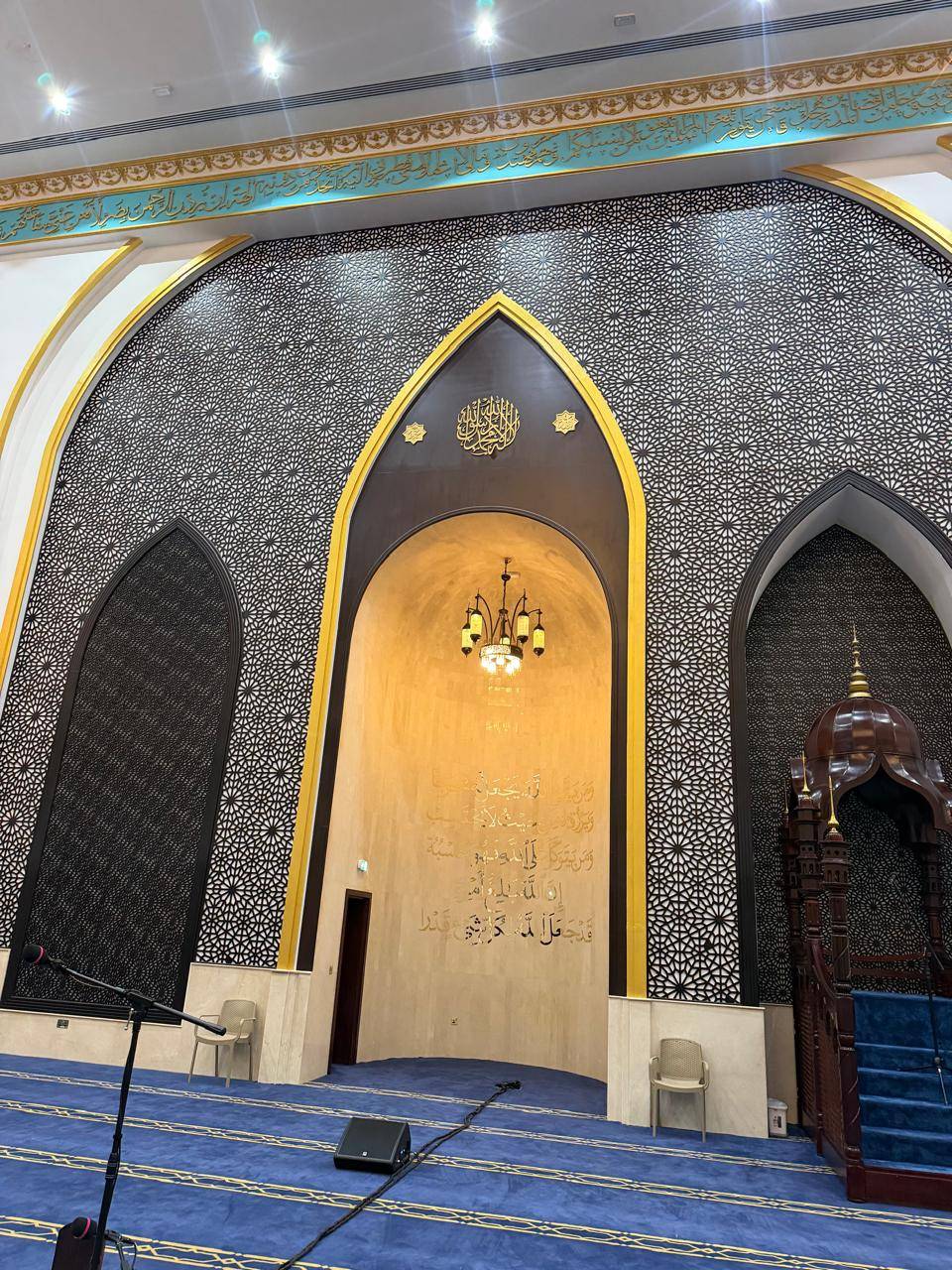 A finished musalla: carved mihrab, geometric Qibla wall panelling and a traditional wooden minbar.
Looking at recent mosque and musalla joinery projects is the fastest way to check whether a contractor has delivered this scope before.
The four cost drivers behind every mosque joinery quote
Four things decide the number: material, measured area, carving and calligraphy complexity, and whether design plus installation sit inside the price.
1. Material
| Material | Typical use | Indicative face rate | | Solid hardwood such as teak, mahogany or oak | Minbar, mihrab, main doors | AED 900 to 1,800 per m² | | Hardwood veneer on MDF | Wall panelling, storage units | AED 220 to 450 per m² | | HDF with decorative laminate | Back of house, ablution areas | AED 150 to 300 per m² | | GRC or glass fibre composite | Large Qibla wall cladding, external arches | AED 350 to 900 per m² |
Solid hardwood is the right choice where an element is touched daily or spans a long distance. Laminate is fine in service areas. Mixing the two across a package is normal and is one of the easiest ways to hold a budget.
2. Measured area and linear metres of trim
Panelling is priced per square metre of face, and trim is priced per linear metre. Cornice, skirting, dado rail, architrave and capping all add up quickly across a 120 m² prayer hall. Add 10 to 15 percent for waste and cutting on carved panels.
3. Carving and calligraphy complexity
A repeating geometric pattern cut from a single template is the cheapest decorative option. Hand carved Arabic calligraphy with an illuminated backing is the most expensive. The gap between the two on the same wall can be three or four times the price.
4. Whether design and installation are included
Some suppliers quote supply only, which looks cheaper until you add a separate installer, access equipment, sealing and snagging. Where the quote covers survey, shop drawings, production and installation, the number is higher but it is the number you will actually pay.
Indicative mosque joinery prices in Dubai
The ranges below are indicative Dubai market rates for budgeting at mid 2026. They are fixed only after a site measurement confirms dimensions, material and access.
| Element | Specification basis | Indicative AED | | Minbar | 3 to 5 steps, solid hardwood, carved panels | 18,000 to 45,000 | | Mihrab | Recessed niche with calligraphy panel | 6,000 to 20,000 | | Qibla wall cladding | Per m², hardwood veneer or GRC | 350 to 900 per m² | | Musalla wall panelling | Per m², veneer or laminate on MDF | 220 to 450 per m² | | Calligraphy fretwork screen | Per m², CNC cut and hand finished | 900 to 1,800 per m² | | Door sets | Per leaf set, hardwood or fire rated | 4,000 to 9,000 | | Imam storage and teaching room units | Per linear metre fitted | 1,200 to 2,500 per lin m |
Worked example: a 120 m² musalla in Dubai
| Item | Quantity | AED | | Minbar, 3 step hardwood | 1 | 28,000 | | Mihrab with calligraphy panel | 1 | 12,000 | | Qibla wall cladding | 32 m² at 550 | 17,600 | | Musalla wall panelling | 85 m² at 320 | 27,200 | | Calligraphy fretwork screens | 4 units at 3,500 | 14,000 | | Fire rated door sets | 2 at 5,500 | 11,000 | | Imam storage and Quran shelving | 1 | 6,500 | | Total | | 116,300 |
That sits inside a realistic budget band of AED 95,000 to 150,000 once material upgrades and access conditions are factored in. Swap the solid hardwood minbar for a veneered unit and the package drops by roughly AED 12,000. Carry hand carved calligraphy across the full Qibla wall and it climbs past AED 150,000.
Their team is professional, creative, and highly committed to delivering quality work. Haidar Ali Khan, 5/5, Google review
Approvals, compliance and finishes for places of worship
Joinery in a mosque touches approval routes that ordinary fit-out does not, so build coordination time into the programme. Work on a place of worship in Dubai generally involves the Department of Economy and Tourism for trade licensing, Dubai Municipality for the building permit and inspection, and Awqaf coordination where the mosque sits under its remit or receives charitable funding.
Fire strategy matters too. Door sets on escape routes usually need to be fire rated and fitted with intumescent strips and self closers, and wall panelling must meet the relevant reaction to fire class for its location. Finishes should be low VOC so the hall can be used soon after installation. For the full joinery scope we deliver, see our bespoke joinery and commercial fit-out services.
Timeline from survey to installation
A straightforward musalla package runs about 8 to 14 weeks from first survey to handover. The sequence is broadly fixed, and the approval stage is the one most committees underestimate.
- Site survey and measurement, day 1 to 3. Levels, wall plumb, Qibla bearing, access route and power.
- Design, sample board and shop drawings, week 1 to 3.
- Approval coordination and permit sign off where required, week 2 to 5.
- Workshop production of mihrab, minbar, panelling and screens, week 3 to 9.
- Delivery and site installation, week 8 to 12.
- Snagging, finishing and handover, week 12 to 14.
Ramadan and the two Eid periods change this. Installation during the last ten days of Ramadan is usually not possible, and workshop slots fill two to three months ahead of the season. If your handover target is Ramadan, confirm the workshop slot before drawings are finalised. More on sequencing sits in our commercial fit-out and joinery guides.
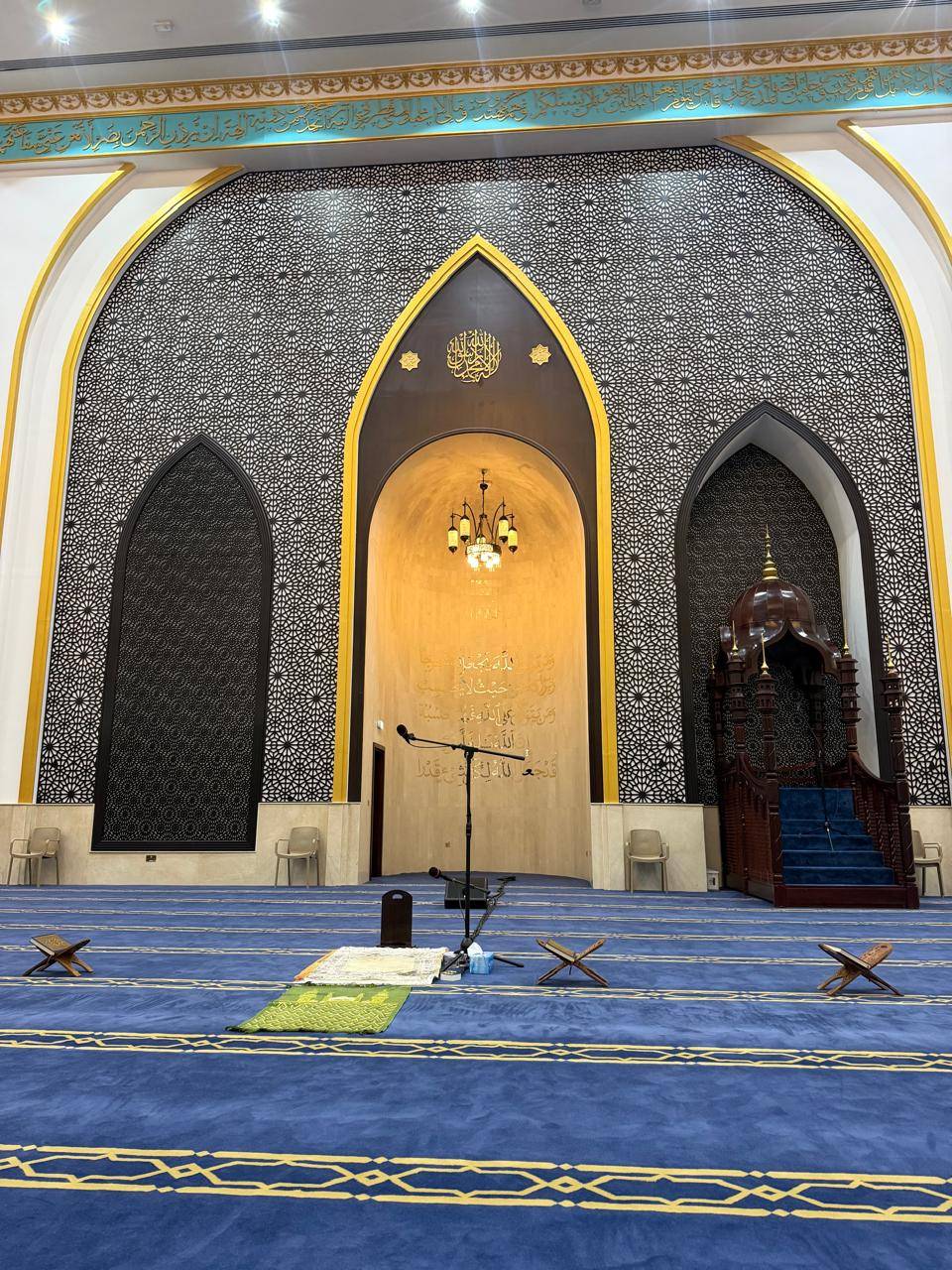 Calligraphy, chandelier coordination and minbar carving are the three items that move a mosque joinery budget most.
How to compare mosque joinery quotes
Compare quotes on scope and specification, not on the headline number. A cheap quote almost always has something missing from the list.
- Itemised scope list naming every element, quantity and dimension
- Material specification sheet naming substrate, veneer or solid species, finish and fire class
- Sample board you can hold before production starts
- Clear statement on what is included: survey, drawings, permits, installation, waste removal, snagging
- Provisional sums flagged as provisional rather than buried in the total
- Programme with named production and installation dates
- Defects liability period and what it covers
Very professional and knowledgable team. Quality work. Naveed Asghar, 5/5, Google review
If a quote arrives without a sample board and a measured scope, treat the number as an estimate rather than a price. To move from indicative ranges to a real figure, request a fixed-price mosque joinery quote and send your drawings or book a site measurement.
Frequently asked questions
How much does mosque joinery cost per m² in Dubai?
Mosque joinery is rarely priced as one rate per m² because the minbar and mihrab are lump sum items. Where panelling dominates, expect AED 220 to 450 per m² for veneer on MDF, AED 350 to 900 per m² for Qibla wall cladding, and AED 900 to 1,800 per m² for carved fretwork screens. A full 120 m² musalla package usually totals AED 95,000 to 150,000.
How long does a mosque joinery project take in Dubai?
Typically 8 to 14 weeks from first survey to handover. Survey and drawings take two to three weeks, approvals add two to five weeks depending on the authority route, workshop production runs three to six weeks, and installation takes two to three weeks. Allow 16 to 20 weeks for larger halls or where approvals are still open.
Is solid hardwood better than MDF for mosque joinery?
Solid hardwood is the right choice for the minbar, mihrab face, main doors and any element handled daily, because it holds carved detail and takes impact. MDF with hardwood veneer performs well on wall panelling, storage and screens at roughly half the cost. Most Dubai mosque packages mix both, with hardwood where it shows and veneer where it does not.
Does the mosque joinery cost include installation?
It depends on the contractor. Supply only quotes look lower but leave you to arrange access, fixing, sealing and snagging separately. Our pricing includes survey, shop drawings, workshop production and site installation, which is why a fixed figure is only issued after measurement.
Does mosque joinery need much maintenance?
Very little if it is specified correctly. Hardwood minbars and mihrab faces need a light clean and a re-oil or re-wax roughly every 12 to 18 months, and veneered panelling needs dry dusting only. Avoid wet cloths on veneer edges and keep ablution area units on moisture resistant substrates.